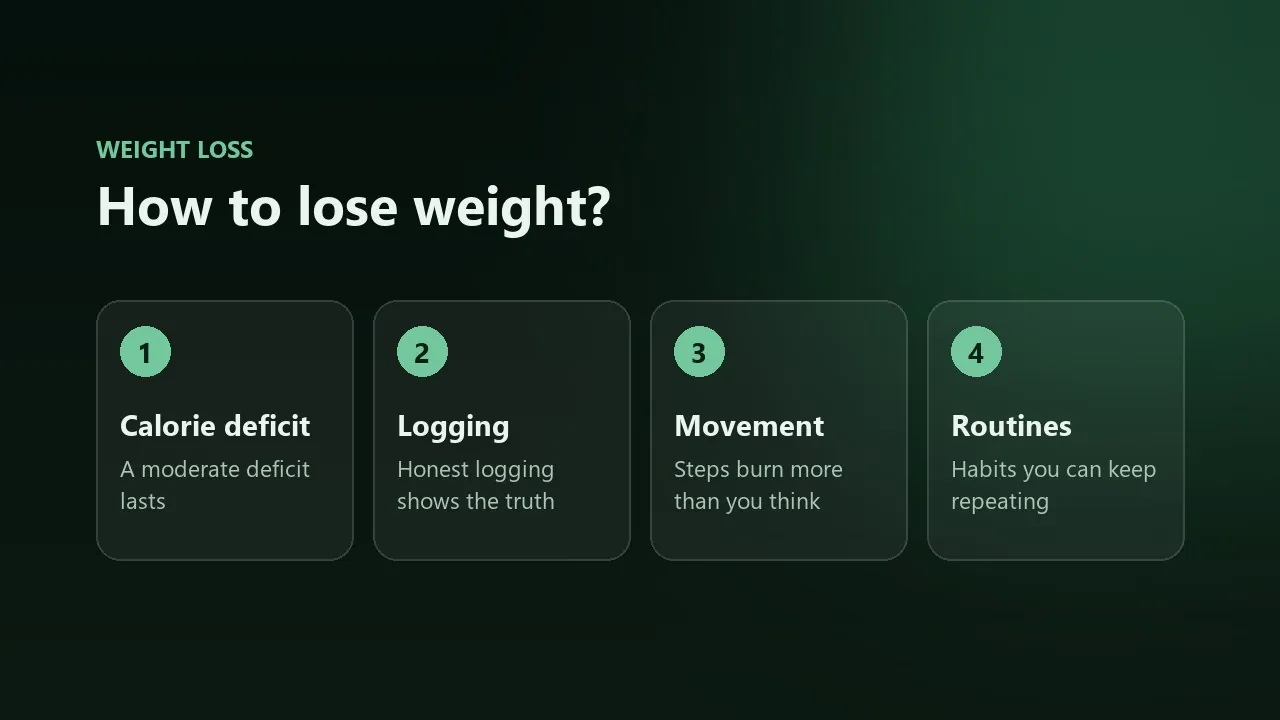
How do you lose weight in a way that actually lasts? I lost almost 40 kilos by tracking calories. It took a moderate calorie deficit, honest logging and an everyday routine I could repeat month after month. In this article I go through the seven steps in the order I would take them.
Each step links to a free RestinCal tool you can use right away. If calorie counting is new to you, read the beginner's guide to counting calories alongside this one.
RestinBot walks you through the first steps: your energy needs, logging your first meal and your weekly review. It also shows instructions for every page with one tap.
What is weight loss based on?
You lose weight when, over time, you take in less energy from food than you burn. This is called a calorie deficit. The name of the diet, your meal timing or any single food does not change that basic fact. They mostly affect how easy it is to stay in the deficit.
That is why the best way to lose weight is the one you can keep following. Ordinary food in amounts you know works better for most people than strict bans.
1Find out how much you burn
You cannot choose a sensible calorie target without knowing how much you burn. Total daily energy expenditure (TDEE) is made up of your resting burn (BMR) and all the movement in your day. The BMR calculator estimates both from your age, sex, height, weight and activity level.
When in doubt, choose the lower activity level. The result is an estimate, and your real expenditure becomes clearer after a couple of weeks of tracking.
Calculate your calorie needsBackground on the formula: What is BMR and how is it calculated?
2Choose a moderate calorie deficit
The biggest mistake is too large a deficit right at the start. It works for a couple of weeks, until hunger and tiredness win. I did best with a daily deficit of about 300–500 kilocalories. It felt small in everyday life, but my weight went down steadily.
- A deficit of about 250 kcal lowers weight slowly but is easy to follow.
- A deficit of about 500 kcal is roughly half a kilo (about one pound) a week, given that a kilo of body fat holds about 7,700 kcal.
- A deficit of more than 750 kcal is hard for most people to keep up for long, and the risk of losing muscle grows.
In the BMR calculator you can choose your rate of loss. The calculator shows the matching daily calorie target and warns you if the target goes too low.
3Log what you eat honestly
A deficit only exists if you really know what you eat. Most people underestimate their intake: cooking oil, tastes while cooking, drinks and weekend snacks are easy to leave out. Log everything for at least the first few weeks, including the bad days.
In the food diary you search a food by name or scan the barcode, enter the amount in grams and see straight away how much of the day's target is left.
Open the food diaryRead more: hidden calories and why the scale won't move.
4Eat in a way that keeps you full
Staying in a deficit is easier when your food keeps hunger away. Two things help the most:
- Enough protein. Protein keeps you full and helps preserve muscle during a deficit. Read: how much protein you need during weight loss.
- A lot of food for few calories. Vegetables, potatoes, soups and berries fill the plate without much energy. Read: volume eating.
The macro calculator splits your calorie target into protein, carbohydrates and fat. For ready-made ideas, browse the recipes, where nutrition is calculated per serving.
Set your macro goals Browse light recipes5Add everyday movement
You can lose weight without hard training, but moving more makes it easier: you burn more and can eat a little more at the same deficit. The easiest way to start is ordinary walking and small everyday choices.
Read: increasing daily activity and is exercise necessary for weight loss?
6Follow the week, not a single day
Your weight can swing by a kilo or two (2–4 lb) within a day because of water, salt and the contents of your gut. A single morning reading does not tell you whether the deficit is working. Weigh yourself at the same time in the morning a few times a week and look at the weekly average and the direction over several weeks.
See the weekly summary Log your weightRead: why weight fluctuates from day to day and does a relaxed weekend ruin a calorie deficit?
7Build routines
Motivation comes and goes, routines carry you. When breakfast, lunch and logging repeat in almost the same way, you need fewer decisions, and even bad days pass without much damage. One slip does not ruin anything: log it and carry on as normal at the next meal.
Read: motivation is a myth, routines decide and how sleep deprivation affects hunger.
How fast can you lose weight?
According to the US Centers for Disease Control and Prevention (CDC), people who lose weight gradually, at about 1 to 2 pounds (roughly 0.5 to 1 kg) a week, are more likely to keep it off than people who lose it quickly. In the first week the number can drop more because the body sheds water. After that the pace evens out.
My own weight loss took two years. The pace that felt slow was the one I could keep up, and that is why it worked.
Why am I not losing weight?
- Calories that were not logged. Oils, sauces, drinks and weekends.
- Too short a tracking period. Judge the direction only after 2–3 weeks.
- Water fluctuation. A salty meal or a hard workout can hide fat loss for days.
- Expenditure was overestimated. Drop the activity level by one step and see whether the direction changes.
- Eating back exercise calories. Device estimates are often too high.
Frequently asked questions
How can I lose weight without counting calories?
It is possible if you create the deficit another way, for example with smaller portions and less energy from drinks and snacks. Counting calories is not mandatory, but it quickly shows where your energy really comes from.
How much weight can you lose in a month?
With a moderate deficit, about 2–4 kg (4–8 lb) a month is realistic for many people, and your starting weight affects the pace. Faster loss is harder to maintain.
Do I have to exercise to lose weight?
You do not have to, but movement supports your health, helps preserve muscle and makes it easier to keep the weight off afterwards.
What do I do when I reach my goal weight?
Raise your calories gradually to maintenance level and keep the same routines. Read: maintaining weight after weight loss.
Sources and further reading
Checked 1 October 2026