We have probably all ended up on Wolt wondering what to order. Value for money, calories, salt and macros are all spinning around in your head at once, and being hungry does not make the decision any easier. That is why I collected my own best options for different needs in this article.
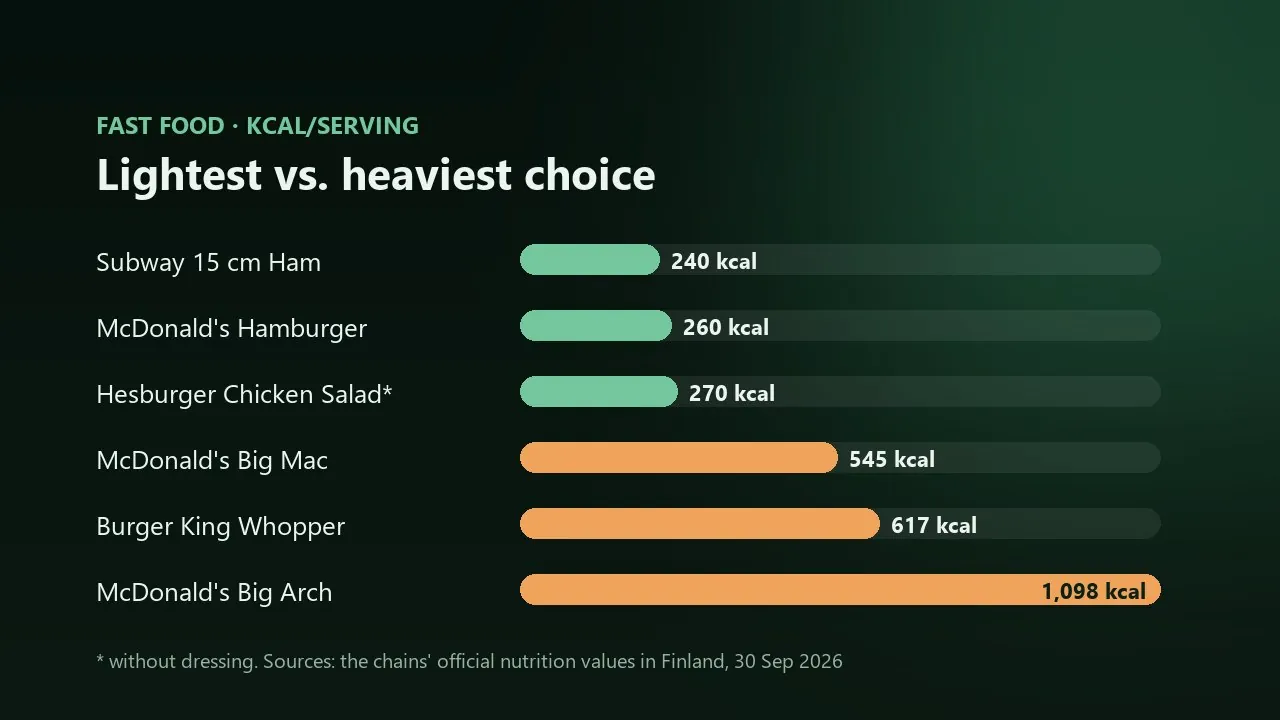
Fast food does not wreck a calorie deficit if you know what to order. The difference between a light and a heavy choice at the same restaurant can easily be 500–800 kilocalories, which is roughly one whole meal. Below are the options from four of the biggest chains in Finland: McDonald's, Hesburger, Burger King and Subway.
Where do the numbers come from? All values were taken from the chains' own Finnish websites or official nutrition tables on 30 September 2026. Two important notes:
- Subway's values for 15 cm subs include the bread, the protein and the vegetables, but not sauces or cheese (except in products that have cheese in the name).
- Hesburger's salad values do not include dressing, the seed mix or croutons.
Recipes and products change, and menus differ between countries, so check the numbers on the chain's own site when needed before you log them in your diary.
The purpose of this article is to offer rough guidance rather than absolute truths. Small choices in the fillings, such as leaving out the mayonnaise or the cheese, make a big difference over time if you eat fast food regularly.
1. When you want as few calories as possible
If the goal is simply to keep the meal light, these are the lightest main items at the big chains:
| Item | kcal/serving | Protein | Salt |
|---|---|---|---|
| Subway 15 cm Ham | 240 | 17 g | 1.3 g |
| Subway 15 cm Turkey | 246 | 20 g | 1.6 g |
| Subway 15 cm Chicken Breast | 256 | 21 g | 1.3 g |
| McDonald's Hamburger | 260 | 13 g | 1.2 g |
| Subway 15 cm Chicken Teriyaki | 270 | 22 g | 1.3 g |
| Hesburger Chicken Salad (without dressing) | 270 | 32 g | 3.5 g |
| Burger King Hamburger | 277 | 14 g | 1.2 g |
| McDonald's Cheeseburger | 308 | 16 g | 1.6 g |
| Burger King Cheeseburger | 316 | 16 g | 1.6 g |
| Burger King Whopper Jr. | 318 | 14 g | 1.3 g |
| Hesburger Mini Hamburger (Minihampurilainen) | 343 | 15 g | 1.2 g |
Sources: the chains' official nutrition values in Finland, checked 30 September 2026. Subway without sauces and cheese.
Subway's light subs look good in the table, but the sauce changes the picture quickly. If you want to keep a sub light, ask for only a little sauce or pick a lighter one, and add plenty of vegetables. They add size with almost no calories, which is the same idea as in volume eating.
2. When you want the most protein per calorie
Protein keeps hunger away for longer, so in a calorie deficit it is worth looking beyond plain calories at how much protein you get for each calorie. Ranked that way, the top looks like this:
| Item | kcal/serving | Protein | g / 100 kcal |
|---|---|---|---|
| Hesburger Chicken Salad (without dressing) | 270 | 32 g | 11.9 |
| Subway Korean Pork salad | 164 | 16 g | 9.8 |
| Subway Chicken Breast salad | 262 | 22 g | 8.4 |
| Subway 15 cm Chicken Breast | 256 | 21 g | 8.2 |
| Subway 15 cm Chicken Teriyaki | 270 | 22 g | 8.1 |
| Subway Chicken Breast wrap | 468 | 35 g | 7.5 |
| McDonald's Double Cheeseburger | 462 | 27 g | 5.8 |
| Burger King Whopper | 617 | 28 g | 4.6 |
Hesburger's Chicken Salad is in a class of its own for protein, but note two things. The dressing is not included in the numbers, and the salad already contains 3.5 grams of salt. If your goal is to get enough protein in a calorie deficit, it is still one of the best options in the whole fast food field.
If it simply has to be a burger, the McDonald's Double Cheeseburger is a surprisingly good compromise: 27 g of protein for under 500 kilocalories.
3. When you want a real burger
Sometimes a salad just will not do, and that is completely fine. In that case the size difference matters more than which chain you order from:
- McDonald's Big Mac, 545 kcal/serving
- Burger King Whopper, 617 kcal/serving
- Hesburger Double Burger (Kerroshampurilainen), 668 kcal/serving
- Hesburger Mega Burger (Megahampurilainen), 1,080 kcal/serving
- McDonald's Big Arch, 1,098 kcal/serving and 4.1 g of salt
The biggest burgers alone contain half of many people's daily calories, before the fries or the drink. My own rule of thumb is to choose a burger without the words "double", "mega" or "XXL" in its name, and to finish the meal with light sides.
4. When you are watching salt
According to the Finnish nutrition recommendations, an adult should get less than 5 grams of salt a day, which is less than a teaspoon. With fast food that fills up surprisingly easily, and often in exactly the products people think of as healthy:
- Subway Spicy Italian wrap, 4.8 g of salt
- Subway Italian B.M.T. wrap, 4.8 g of salt
- Burger King Beef Wrap, 3.8 g of salt
- Hesburger Chicken Tortilla (Kanatortilla), 3.7 g of salt
- Hesburger Chicken Salad, 3.5 g of salt (without dressing)
The lowest-salt main items are the ordinary small burgers (the McDonald's and Burger King Hamburger, 1.2 g) and Subway's 15 cm ham and chicken subs (1.3 g). Salt is also worth watching because a salty meal increases the amount of fluid in your body. That often shows on the scale the next morning even though no fat has been gained. More on that in the article on water retention vs body fat.
5. Traps that are not as light as they look
Wraps and salads look light, but the numbers tell a different story:
- Burger King Beef Wrap, 712 kcal/serving, which is more than a Whopper.
- Subway Spicy Italian wrap, 662 kcal/serving, while the 15 cm sub with the same filling is 383 kcal/serving.
- Burger King Crispy Chicken Wrap, 653 kcal/serving.
- Hesburger Chicken Tortilla, 573 kcal/serving.
- McDonald's Fiesta salad with chicken, 495 kcal/serving, almost as much as a Big Mac.
The common factor is usually the sauce, the cheese, breaded chicken or a large tortilla. The word "salad" or "wrap" does not tell you anything yet, so it is worth checking the numbers.
6. Sides, dips and drinks
The main item is often only half of the meal's calories. The rest comes from sides, dips and the drink:
- Fries. McDonald's regular 327 kcal/serving, Burger King M 275 kcal/serving.
- Light sides. Hesburger's Mini Salad 25 kcal/serving (without dressing), Burger King's Side Salad 15 kcal/serving, McDonald's baby carrots 31 kcal/serving and apple slices 30 kcal/serving.
- Nuggets. 4 pieces are about 180 kcal at both McDonald's and Burger King, a surprisingly moderate extra if you want something crispy.
- Dips. McDonald's garlic dip is 153 kcal/serving, while the BBQ dip is 48 kcal/serving and the sweet and sour 51 kcal/serving. A threefold difference in a small tub.
- Drinks. Regular cola is about 42 kcal / 100 ml, so a 0.4 litre drink adds about 170 kcal. A zero drink or water is the easiest saving in the whole meal.
For example, a Big Mac, regular fries and a regular cola add up to about 1,040 kcal. A cheeseburger, baby carrots and a zero drink are about 340 kcal. The same place and the same order, but a difference of about 700 kilocalories.
7. Other Wolt classics, such as pizza, kebab, sushi and poke
Smaller restaurants do not usually publish nutrition values, so a few rules of thumb work better for them than exact numbers:
- Kebab. Kebab with rice or salad is usually lighter than kebab with fries. Ask for the sauces on the side so you can decide the amount yourself.
- Pizza. A thin base, vegetables and chicken or ham are lighter than double and cheese toppings. A whole pizza is easily a full day's calories for many people, so leaving half for the next day is a perfectly good strategy.
- Sushi. Nigiri and ordinary maki are lighter than deep-fried rolls or rolls topped with mayonnaise. Besides the fish and rice, the calories often come from exactly the sauces and the tempura.
- Poke bowl. A bowl built from scratch is one of the best options on Wolt when you choose part salad as the base, chicken, salmon or tofu as the protein and ask for the sauce on the side.
When there are no exact numbers, log the meal in your diary slightly on the high side. That is more honest than assuming the best, as I wrote in the article on hidden calories.
My own picks for different situations
Summary
The lowest-calorie fast food does not mean a miserable meal. The biggest difference comes from a few choices: the size of the item, the sauce, the side and the drink. A small burger, a light side and a zero drink, or a high-protein salad or sub, easily keep the meal under 400 kilocalories. The biggest burgers and wraps, on the other hand, can contain more calories than many home-cooked lunches and dinners put together.
Frequently asked questions
What is the lowest-calorie burger?
Among the big chains in Finland, the McDonald's regular Hamburger (260 kcal) and the Burger King Hamburger (277 kcal). Of the cheeseburgers, the McDonald's version is 308 kcal and the Burger King Whopper Jr. is 318 kcal.
Is a salad always the lightest option?
Not always. The McDonald's Fiesta salad with chicken is 495 kcal, and Hesburger's salad values do not include dressing, seeds or croutons. The dressing can easily add hundreds of kilocalories to a salad.
Which fast food has the most protein?
Relative to calories, Hesburger's Chicken Salad (32 g / 270 kcal) and Subway's chicken subs and salads (about 21–22 g / 256–270 kcal). The largest amount of protein in a single item is in Subway's Chicken Breast wrap (35 g, 468 kcal).
How do I log fast food in a calorie calculator?
Look for the product in the food database or add it yourself using the chain's official nutrition values. Log sauces, dips and drinks separately, because they are the easiest to leave out.
Read next: Beginner's Guide to Calorie Counting.
Sources
- McDonald's Finland: product nutrition values
- Hesburger: nutrition values and allergens
- Burger King Finland: products and nutrition content
- Subway Finland: nutrition table (June 2026)
- Finnish Food Authority: salt and recommended intake (in Finnish)
Nutrition values checked 30 September 2026. The chains update their recipes, so the numbers may change.