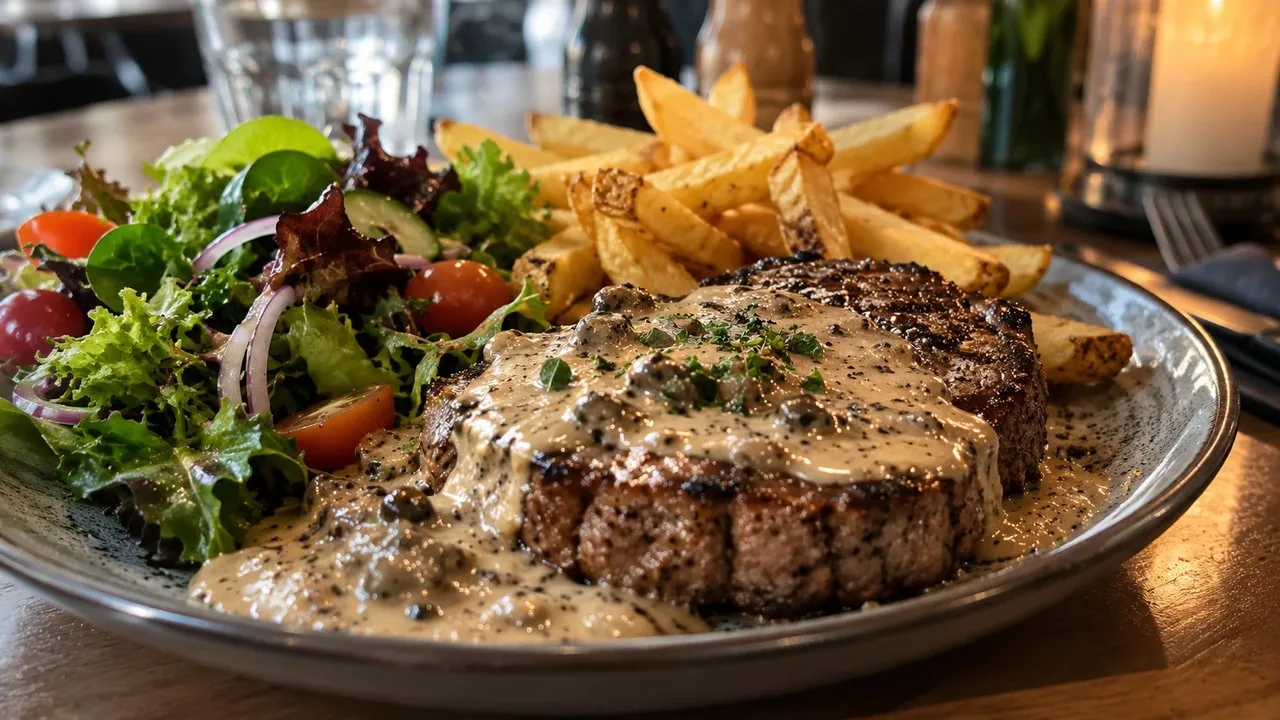
You order a salad at a restaurant and feel like a responsible adult for a moment. In the kitchen, the chef adds “just a splash” of oil, which is easily four tablespoons, or about 480 kcal. That’s exactly why it tastes so good. A restaurant’s job is to make you come back, not to protect your calorie deficit.
I didn’t stop eating out to lose weight, and you don’t have to either. At a restaurant you eat the kitchen’s decisions, and you can’t see them on the plate. Once you know where the calories hide, your estimate gets closer and you can enjoy the meal without doing maths in your head afterwards.
Butter is the kitchen’s secret ingredient
At home I fry food in a teaspoon of oil, because I know I’ll have to log it. At a restaurant nobody logs anything. The pan gets a generous pour of oil, the steak is finished with a knob of butter, and the mashed potatoes contain more butter than you would dare to add at home.
A tablespoon of oil has about 120 kcal and a tablespoon of butter about 100 kcal. A couple of spoonfuls doesn’t show on the plate at all, but it shows in the calories: an ordinary fish dish can gain a couple of hundred kilocalories from the cooking alone.
Fat isn’t the enemy of food. It makes food taste good, which is why chefs use it. The only problem, calorie-wise, is that you can’t see it.
Sauce, bread basket and drinks
Cream sauce, aioli or an oily salad dressing easily adds 150–300 kcal to a meal. A slice of bread from the basket with butter is about 150 kcal, and when the wait gets long, there are two. Add a soft drink or a glass of wine, and the dessert menu arrives at the table just to be looked at.
None of these is a big deal on its own. Together they can add up to more than the main course, and that’s exactly why they get left out of the estimate. Fast food works the same way with sides and drinks: the lowest-calorie fast food options.
Portions are sized for a hungry person
Restaurant portions are made so that nobody leaves hungry or feels they paid too much. There’s often clearly more pasta, rice or fries than I would put on my own plate.
The other part happens in your head. When the plate is in front of you and you’ve paid for it, it’s easy to finish it, even if your hunger was gone halfway through. Clearing the plate feels sensible even when your stomach disagrees. Once you notice this, you can leave the rest or take it home without feeling guilty.
How I estimate a meal without scales
- First check whether the nutrition facts are published. Many chains list them online. On RestinCal’s food pages you’ll find, for example, McDonald’s meals.
- Break the meal into parts. Meat or fish, side, sauce and vegetables. Look the parts up in the food diary and estimate the amounts with your hand: a palm-sized piece of meat is about 100–150 grams.
- Add the fat separately. I add a tablespoon or two of oil to my estimate, because there is almost always more than you’d think.
- Log just a calorie estimate if breaking it down feels like work. You can log something like “Restaurant meal ~900 kcal” in the diary. A rough estimate is far better than an empty day.
Enjoy the meal, your week can take it
One restaurant meal won’t ruin your week, and two don’t need to become a big deal either. If I know I’m eating out in the evening, I eat lighter and higher in protein during the day, and I look at the weekly average rather than a single day.
What matters most is that the meal gets logged somehow. If you skip it because the number isn’t exact, your diary looks better than reality, and the scale will wonder about it later. More on this: does the weekend ruin your calorie deficit?
Frequently asked questions
How many calories are in a restaurant meal?
It varies a lot. An ordinary main course is often 600–1,200 kcal, and with a starter, a drink and a dessert the meal can go over 1,500 kilocalories.
Why does restaurant food have more calories than home cooking?
Restaurants use more butter, oil and cream, sauces are more generous and portions are bigger. On top of that, bread, drinks and dessert easily slip in without you noticing.
How do I estimate restaurant food calories without scales?
Break the meal into parts, look them up in the food diary and add some fat to the estimate. Your hand works as a measure: a palm-sized piece of meat is about 100–150 grams and a fist-sized portion of rice or pasta about 150–200 grams.
Can I eat out while losing weight?
Yes. The overall picture is what counts. When the meal is logged and the rest of the day fits around it, restaurant food fits into a calorie deficit.
Which restaurant meal should I choose?
One where you can see what’s on the plate: grilled meat or fish, potatoes or rice, and vegetables. You can ask for the sauce on the side, so you decide how much of it you have.